

Recommendation and personalization system is one of the most important (if not the most important) marketing tools for an online store. Properly implemented, it directly affects the average order value (AOV) and conversion rate, which is why the implementation priority is high. It is essentially the most important tool, right after basic analytics on the site.
What is a recommendation system?
A recommendation system (or recommendation engine, recommendation system, recommender) is a technology used to suggest products (but also movies, events, articles) to users (customers, visitors, app users, readers).
Since e-commerce environments often have many users (many thousands) and many items (also often several thousand), building effective recommendation systems is difficult and resource-intensive. Imagine a store where an experienced salesperson knows customer preferences and makes tailored suggestions that increase satisfaction and sales. In online commerce and marketing, this role is fulfilled by such an automated salesperson – the recommendation system.
Attribute-based recommendation systems
Content-based recommendation systems suggest items similar to those the user has, for example, viewed before, without relying on the preferences of other users. The information used to build these models comes from two main sources.
Attribute-based recommendation systems focus on the interactions of a single user. A common method is calculating attribute similarity between viewed items and suggesting similar ones.
Popularity-based recommendation systems
Popularity-based recommendation systems suggest items (products, movies, articles, etc.) to users based on their overall popularity among all users, without considering individual preferences. They are based on collecting popularity signals such as the number of views, clicks, purchases, ratings, shares within a specific time window.
Popularity-based models are easy to implement and scale and do not require advanced technological infrastructure to apply. Their main drawback is the lack of personalization. All users receive the same recommendations.
They also tend to perpetuate popularity (sales of already well-selling products), which impoverishes the long tail. Long-tail products have no chance of selling. They perform poorly with niche interests and contextual changes in user preferences.
AI predictive recommendation systems
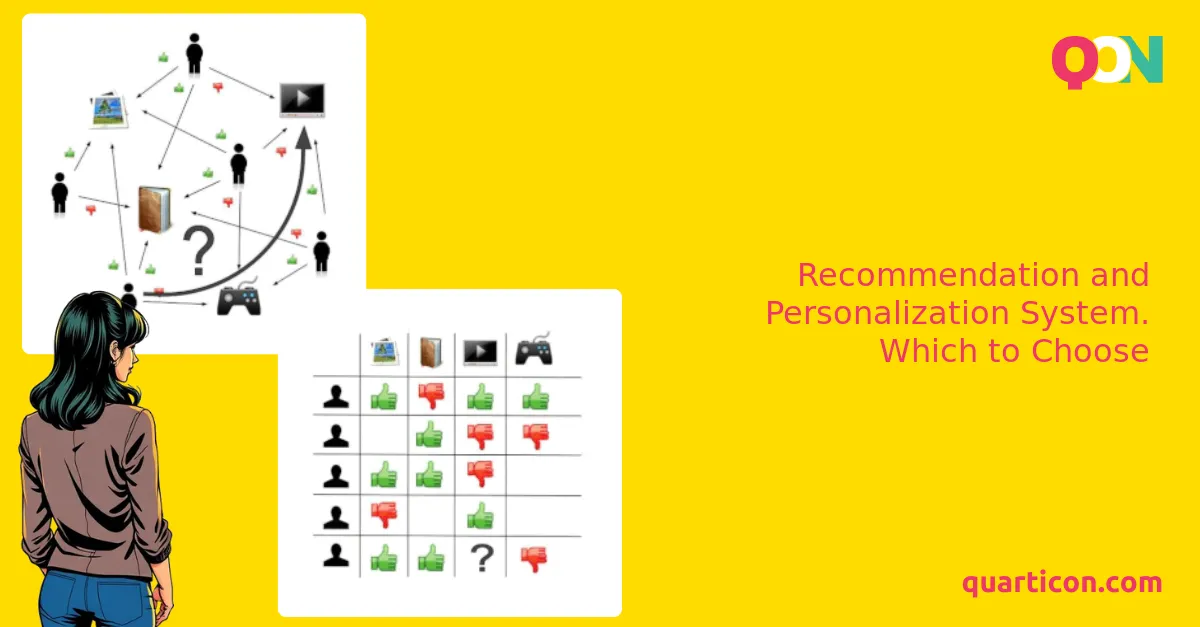
AI-based recommendation systems use past interactions of the entire user base (anonymous on the site) to generate recommendations. These methods outperform content-only approaches in efficiency. Exceptions are situations where there are significantly fewer items than users or when interactions are very rare or in specific types of sites (e.g., classifieds).
From a technical standpoint, these can be neighborhood-based algorithms – the goal is to find the k nearest neighbors (users with the most similar ranked items) and recommend the N best items that these neighbors liked and that the user has not yet seen. These are also techniques that extract rules from interaction matrices (e.g., users who bought A also bought B).
AI-based recommendation systems work well for both mainstream and niche users. Since recommendation models must immediately reflect new interactions, models require continuous retraining. Each new recorded interaction on the site increases the recommendation efficiency.
Why invest in external, specialized recommendation tools
Many built-in store platform solutions are rule-based mechanisms with limited capabilities and without the use of advanced AI models. They do not offer adaptive personalization or learning from user behaviors, instead using popularity-based recommendations – perpetuating patterns, e.g., sales of already popular products.
External recommendation platforms provide advanced algorithms – machine learning models, combining behavioral, contextual, and product signals, hybrids of all models, and ready A/B tests. Better matching of recommendations to user needs means higher AOV and higher conversion. Thus, faster business effects as well.
Is implementing an external recommendation system complicated?
No, that’s a myth. Implementing an external recommendation system does not have to be complicated and is often cheaper and more effective compared to in-house solutions and certainly faster, cheaper, and safer than building everything from scratch. Below are brief, convincing counterarguments and practical tips.
Most providers offer solutions that allow launching recommendations within days or weeks without major backend changes. All that is needed is a basic product/content feed and event tracking (views, clicks, transactions). There is no need to transfer the entire logic or user base, as in MA or CDP systems. Many providers (like Quarticon) offer JS widgets that work without deep backend integration and without the need for IT team involvement.
“We don’t trust external providers” – is often heard. And rightly so. An entity that is European, a data processing agreement + minimal, anonymized events should solve most concerns. Recommendation systems do not need access to personal data. Even working with registered users is based on anonymized identifiers.
It is worth trying the Quarticon recommendation and personalization system not only in the context of e-commerce. Quarticon integrates all 3 types of recommendation systems in one tool: AI, popularity-based, attribute and content-based. Schedule a Quarticon recommendation demo.