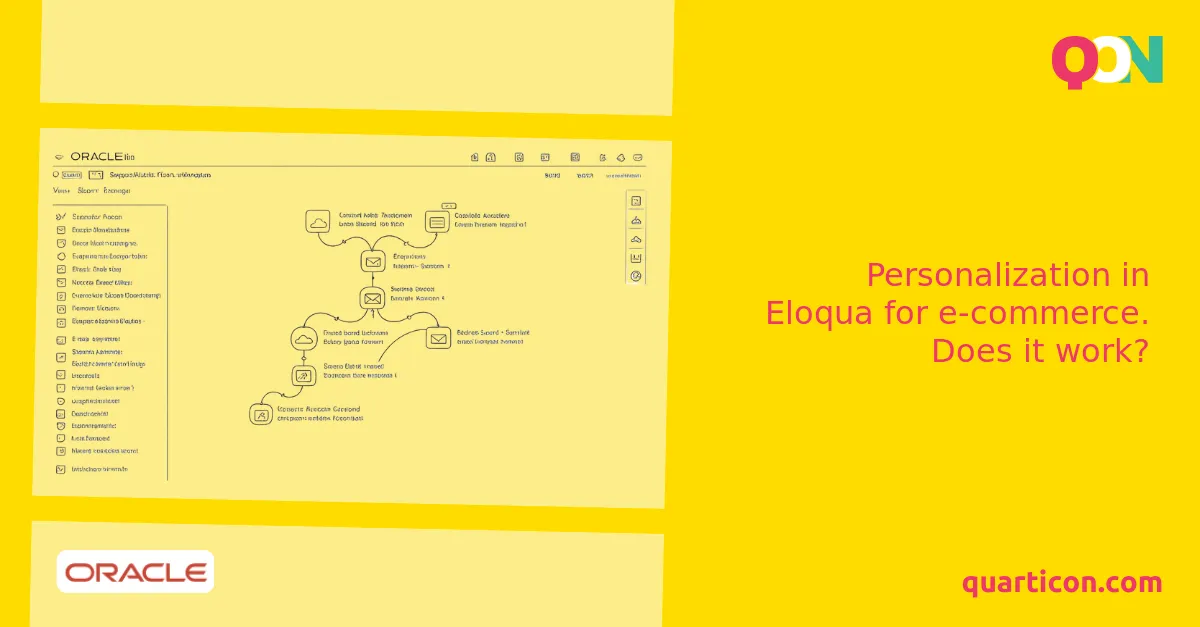
Eloqua (Oracle) enables email personalization, but it does not fully match specialized 1:1 engines like Prefixbox or Quarticon in terms of scale and recommendation sophistication. This makes Eloqua a tool that is not often chosen by teams in e-commerce companies.
What is not possible in Eloqua is also very difficult to achieve in other tools of this type. However, through simple integrations, full personalization of mailings, which is essential in e-commerce applications, can be achieved.
What personalization solutions does Eloqua offer?
Eloqua offers fairly basic email personalization solutions. These include:
- inserting variables (merge fields) in email/SMS content,
- dynamic content blocks dependent on segments/conditions in campaigns and automation programs,
- basic product recommendations through integrations with e-commerce/external systems (e.g., recently viewed, most purchased) implemented through complex integrations and extensions,
- advanced automations based on rules, events, and user behaviors (campaign canvas, programs, engagement programs).
In e-commerce applications, it turns out that this range is too limited and insufficient. The number of handled segment cases and product suggestions is limited by the capabilities of the team managing the campaigns. The question then boils down to how many such segments a single person can create and control. The answer, of course, is: not many.
Specialized Recommendation Engines
Quarticon, or Prefixbox belong to the group of AI Personalization & Product Recommendation Engines. They are not CDPs or ordinary marketing automation tools – they are specialized ML systems for 1:1 personalization. Their main task is to automatically generate personalized product/content recommendations and make real-time decisions for a single user. They use machine learning models, behavioral signals, and product feeds to deliver contextually tailored content.
Decisions are made in real-time: serving recommendations in milliseconds using real-time decisioning/API. Recommendations work on the site, in email, push, SMS, ads, call-center. In the case of Quarticon, embedding in emails and web pushes is additionally very simple, without IT department support.
What are the limitations of Eloqua compared to recommendation engines
Advanced 1:1 recommendation models (strong real-time personalization at the single-user level with more complex ML algorithms) are unavailable in Eloqua. These solutions are offered by external partners. The best quality (measured by conversion increase) is offered by specialized recommendation engines like Quarticon, or Prefixbox.
The ability to scale very large sets of content variants and test hundreds of microsegments requires specialized solutions. Such scale and detail are unattainable in any rule-based tool. More advanced contextual matching (cross-channel), as well as very important in the context of e-commerce – processing and handling product feeds in real-time, are more mature and advanced in specialized tools like Prefixbox or Quarticon.
How to get product recommendations in emails in Eloqua?
If you need mass but relatively simple personalization (merge fields + a few dynamic variants + behavior rules) — Eloqua is usually sufficient and is well integrated with corporate CRM/marketing automation systems. This is enough for B2B applications.
If you require true 1:1 personalization (thus in a B2C and e-commerce environment) based on advanced recommendation models, real-time dynamic content matching, and wide variant scaling, consider a specialized solution (Quarticon / Prefixbox).
Quarticon additionally offers a solution that combines Quarticon AI recommendations with Eloqua without integration, which shortens the solution launch time, costs (requires no integration), and guarantees ease of use (at the Eloqua side, these will be easily manageable with HTML snippets).
See a demo of product recommendations in Eloqua from Quarticon based on so-called AI-mails (image API).