
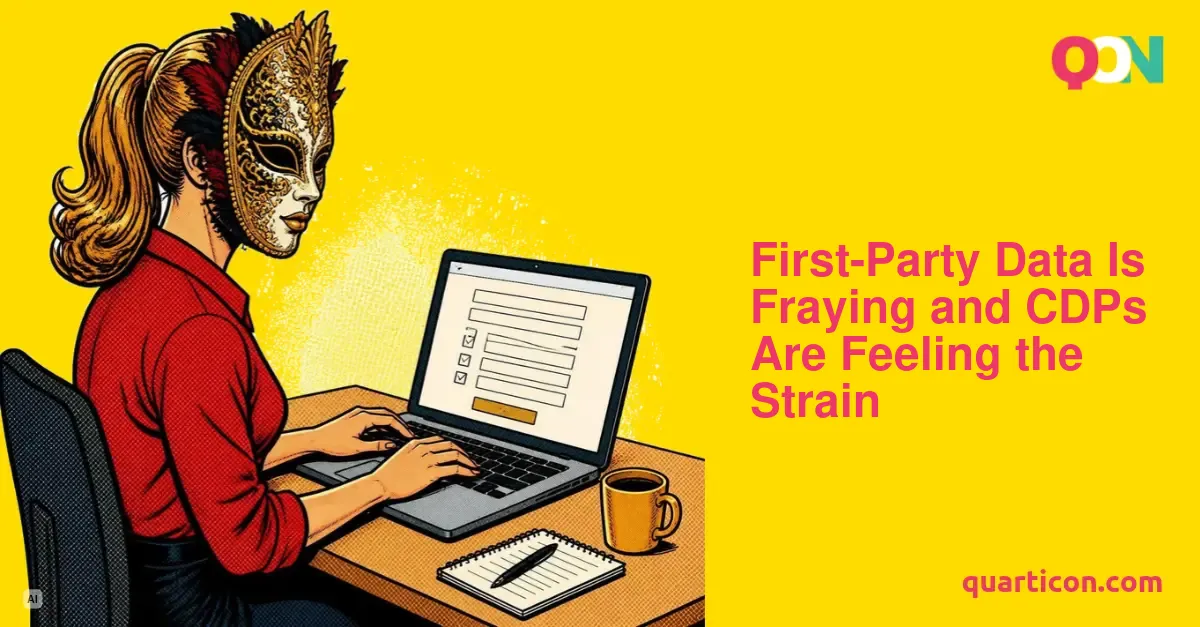
Customer data platforms are built on a simple promise: bring customer information together, make sense of it, and use it to deliver more relevant experiences. But that promise depends on a fragile assumption – that the information customers provide is accurate.
That assumption is getting harder to make.
Research cited by eMarketer found that 53% of U.S. adults had opted out of data collection, targeting, or tracking on AI platforms. Another 31% said they had provided a fake name or birthday. The same research points to broader discomfort with data-driven personalization: 59% of U.S. adults were uneasy with AI using their email addresses to personalize ads, while 52% were uncomfortable sharing their browsing history.
These figures describe attitudes and behavior on AI platforms, not CDP users specifically. But they point to a challenge that matters for any system built on customer registration data: people may opt out or provide information that looks real but isn’t.
When a false detail becomes a flawed segment
A fake name may seem harmless. A false birthday may seem like a small act of self-protection. But when a company treats registration details as ground truth, inaccurate information can travel far beyond the sign-up form.
A mistaken age can put someone in the wrong lifecycle campaign. An inaccurate gender marker can skew a targeted segment. Those assumptions may then shape product recommendations, email content, and customer analysis in marketing automation campaigns.
The problem is not just that one data point is wrong. It’s that automated systems can use that data to make decisions repeatedly, giving a flawed input the appearance of a reliable signal.
Behavioral and transactional data offer a different kind of evidence. A purchase, a product view, or a repeated interaction records what someone did. A registration field records what someone said. Both can be useful, but they should not carry the same level of confidence by default.
A shrinking pool, with more uncertainty inside it
Opt-outs reduce the number of people available for tracking-based marketing. If some of the remaining registered users have also supplied inaccurate details, the usable audience may be smaller than the headline database size suggests.
That creates a risk of a downward cycle:
- Less trustworthy data leads to weaker targeting.
- Weaker targeting can reduce campaign performance.
- Poor results may prompt brands to optimize the wrong parts of the campaign – creative, channels, or timing – while the underlying data problem goes unnoticed.
If customers then receive irrelevant messages, they may become even less willing to share information or remain opted in. The result is not simply a smaller audience, but a less dependable foundation for marketing decisions.
False precision can be costly
A detailed customer profile can look valuable even when its inputs are unreliable. That’s the danger of false precision: teams may trust a segment because it is specific, not because it is accurate.
When campaigns miss the mark, marketers may adjust their messaging or targeting rules without questioning whether the profile itself is sound. Over time, that can reinforce bad assumptions and train models on misleading signals.
The answer is not to abandon customer data platforms. It is to stop treating every field as equally dependable.
A narrower ceiling, not the end of personalization
This is not necessarily a ceiling on personalization as a whole. It is a warning about marketing automation that depends too heavily on registered-customer data, especially when demographic details are assumed to be accurate without verification.
Personalization based on observed actions is still very useful. Especially personalization delivered in anonymous sessions in real time. Recommendation engines feel this gap. But CDPs or MA tools that rely on claimed attributes as unquestioned facts risk building sophisticated campaigns on unstable foundations.
The strategic shift is straightforward: trust what customers do in real time (and anonymous customers too, of course) more than what a form says they are, and make uncertainty visible in the system. A smaller, better-understood set of signals can be more valuable than a larger database that only looks precise.