
The number of subscribers is easy to report, which is one of the reasons for its popularity. However, the size of the list does not necessarily indicate its business value. A large list has even become a vanity metric. We wrote about the weaknesses of mass email address acquisition ← here. So what are the alternatives?
A smaller group of recipients with strong purchase intent can achieve better results than a much larger database of inactive contacts. The important question is not: „How many email addresses have we collected?” It should be: „How many people have given us a reason to contact them again?”.
The most effective alternative to mass subscriber acquisition is improving the user experience while visitors are actively using the site. This is especially important because we must be prepared for users to become more anonymous over time (also as a result of legal solutions) and for internet users to avoid leaving their email addresses. We should not fight this, but adapt to it.
A person who is currently searching for, comparing, or evaluating products has already provided valuable signals, even if they have not given their email address. Their behavior may reveal more direct intent than the contact form itself. This creates an opportunity to optimize the visit in real time.
Make It Easier to Discover Products
Not every visitor arrives with a specific product in mind. Some know what problem they want to solve but do not know which product will be suitable. Others browse the offering in search of inspiration.
Product discovery tools can help visitors by providing category navigation, recommendations based on use cases, comparison features, carefully curated collections, „Frequently bought together” suggestions, recently viewed products, or personalized category pages.
This approach turns browsing the offering into a useful interaction instead of treating the visitor as an email address waiting to be acquired.
1. Recommendation Engines for Anonymous Visitors
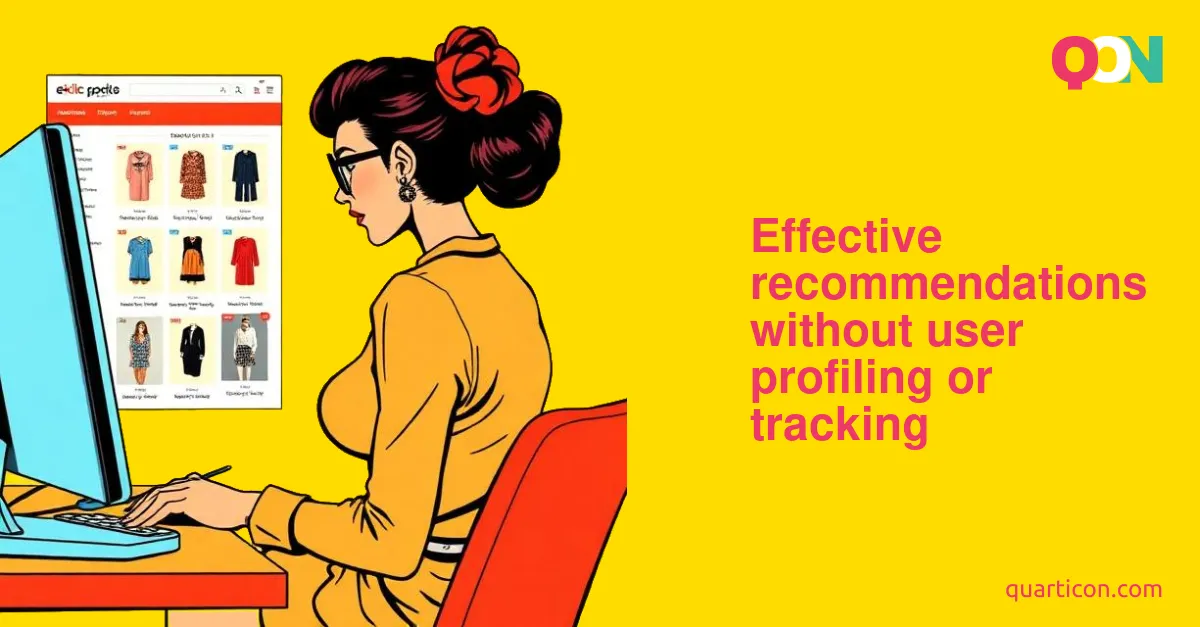
Recommendation engines do not have to wait until visitors provide their data. They use completely anonymous contextual and behavioral signals, such as pages viewed, products compared, search terms entered, categories visited, the campaign or channel from which the user arrived, device and session context, products added to or removed from the cart, as well as current and historical transactions.
These signals can support recommendations for anonymous users without requiring them to create an account or provide an email address. For example, a visitor browsing running shoes may receive relevant suggestions for socks, accessories, similar products, or alternatives in different price ranges.
The advantage is the timing. The recommendation appears when the visitor is already considering a purchase, rather than several hours or days later in an inbox full of unrelated messages.
2. On-Site Search as a Conversion System
On-site search is often treated as a utility tool rather than a marketing channel. This is a mistake.
Search queries are a direct expression of intent. A visitor entering „waterproof trekking jacket” communicates more than someone who merely opened a promotional email.
An effective AI search engine for an e-commerce store recognizes synonyms and different spelling variants, returns relevant results even when the terms used differ from the names in the catalog, takes product availability and commercial significance into account, supports filters for price, size, color, brand, and use case, displays useful alternatives when there is no exact match, learns from searches that produced no results, and makes it easier to compare product features
Search data can also reveal shortcomings in the way the offering is presented. If visitors repeatedly search for products that are difficult to find, the problem may not be demand but discoverability.
When Should You Collect Email Addresses?
This does not mean abandoning email altogether. Email remains valuable when it is based on a clear exchange of benefits and informed consent.
Instead of adding every visitor to the same audience group, more targeted data collection methods can be used:
- Asking about preferences, not just an email address
- Product guides
- Making it easier to choose categories and/or communication frequency
- Saving a list of products
- Acquiring a subscriber after a valuable interaction
- Determining future contact frequency based on past behavior
This leads to the creation of a smaller but more informative audience group. Such subscribers are easier to segment and more likely to appreciate relevant communication.
The Future Will Depend on Relevance in the Moment
The old growth model treated anonymous traffic as unreliable data. A visitor was considered valuable only after being converted into an identifiable potential customer. That is a mistake!
This model became outdated long ago. Anonymous visitors generate rich behavioral signals that can be used immediately to improve search, recommendations, navigation, and product discovery. Additionally, as a result of ad blockers, cookie deletion, and cookie rejection, most former customers are also anonymous on the site.
Real-time website optimization offers several advantages over mass email address acquisition:
- It reaches people when their intent is active
- It does not depend on whether the message is noticed in the inbox
- It can adapt to current behavior
- It improves the experience for both identified and anonymous users
- It creates value before asking for personal data
- It reduces the pressure to send irrelevant follow-up campaigns
The most important change is the shift from the „collect data first, personalize later” model to the „be useful right now” model.
Quarticon personalizes the experiences of anonymous users. Ask us for details.