
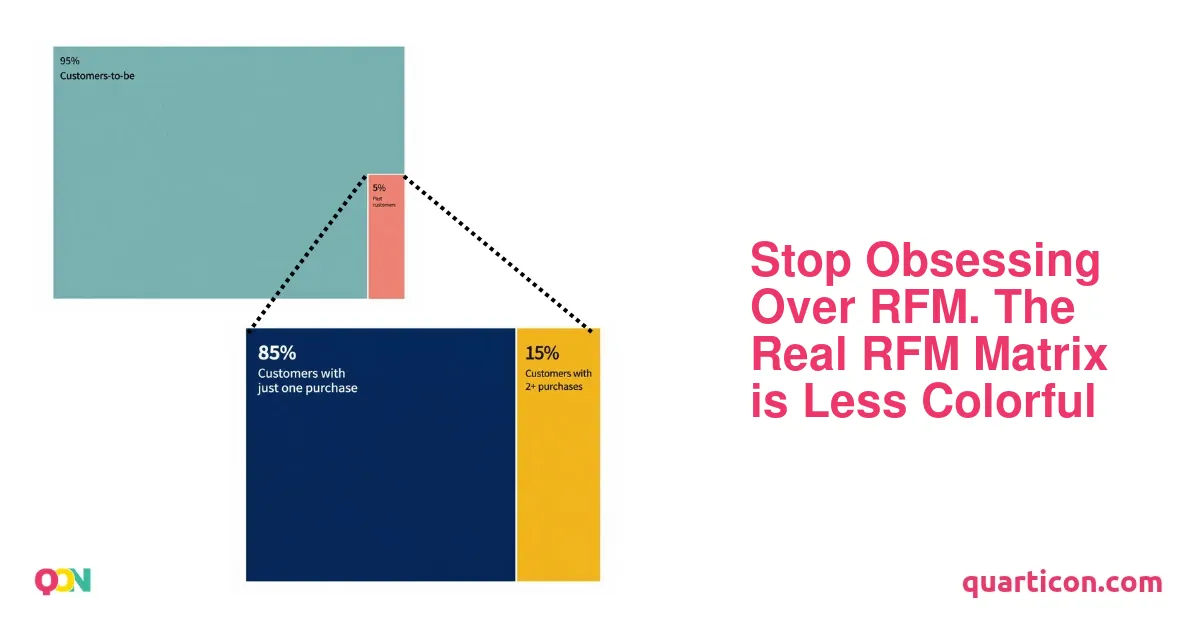
When the real RFM matrix is less colorful: two groups, 85% one-time buyers of a tiny group of 5% of past customers and the real question is why to use RFM analytics in e-commerce at all.
You’ve probably seen colorful RFM matrices dividing customers into groups like Champions, Loyal Customers, Promising, Price Sensitive, Recent Users, Hibernating, and At Risk. But for many e-commerce businesses, the real diagram is much less colorful. RFM – recency, frequency, and monetary value – can be useful when customers regularly replenish, renew, or subscribe. And e-commerce is different.
For businesses selling furniture, appliances, seasonal goods, products people buy for occasional one-off needs or in categories with highly competitive in distribution channels (many vendors / e-commerce stores), RFM can create the appearance of insight without answering the most important question: how do you get more profitable customers to buy?
When RFM ranks the inactive
Imagine that 85% of your registered customers have made one purchase and haven’t returned. RFM may still assign them scores, but frequency is almost always one, and recency mostly tells you how long ago the purchase happened. Monetary value may simply rank the size of their first orders.
You can sort these customers into segments, but a ranking isn’t necessarily an explanation or a useful prediction. A customer who hasn’t bought a sofa again may have stopped shopping with you. Or they may not need another sofa. The score alone can’t tell you which.
That distinction matters in long-cycle categories. A sofa’s useful life varies with its construction and use; one estimate puts the typical range at about 7-15 years. NIQ describes an average replacement cycle of eight to 12 years for major appliances, while a European Environment Agency summary reports a 2023 average lifespan of 12 years and 6 months for large household appliances. The figures measure somewhat different things, but both illustrate why a long gap between purchases doesn’t automatically mean a customer is lost.
Why companies get trapped
RFM is easy to calculate when you already have registration data, an email platform, and a customer dashboard. That convenience can make it feel like the right strategy, even when repeat purchasing isn’t central to the business.
RFM is actually a excellent metric, but … not in your industry. It’s been exported to industries where the fundamental assumptions don’t apply.
RFM works in industries with implicit ongoing customer relationships: banking (you have an account, churn is real), food delivery (recurring weekly or bi-weekly orders are the expected pattern. Non-purchase is deviation from norm), telecom (monthly billing creates natural touchpoints and a continuous relationship contract), insurance/financial (policies renew, relationships persist, churn signals risk).
In all these, the business model assumes the customer stays unless something goes wrong. Silence = problem.
E-commerce (especially durable goods) has no implicit relationship. You buy a sofa. Transaction complete. The relationship ends. No “churn” – just a customer who got what they needed. Silence isn’t a warning sign. It’s normal. The next purchase signal isn’t “they’re still engaged”, it’s “they need something new,” which may be years away.
It’s that familiar infrastructure can keep teams focused on the customers they already have, while the larger opportunity may be visitors who haven’t converted. If most of your traffic has no purchase history, RFM can’t tell you why people leave, what stops them from checking out, or which acquisition channels bring in profitable first-time buyers.
Track what moves the e-commerce business
If repeat purchases are uncertain or rare, focus on metrics closer to the actual growth problem:
- First-visit conversion rate: What share of new visitors make a purchase? Look for drop-offs by device, channel, and key steps in the buying journey.
- Cart abandonment and recovery: How many shoppers add items but don’t check out? Track where they leave and whether recovery messages lead to completed orders.
- Acquisition cost versus first-order contribution: Compare the cost of acquiring a customer with the gross profit or contribution from their first order–not just the order’s revenue or average order value.
If repeat buying is a meaningful part of your economics, RFM may help you understand and serve those customers. If it isn’t, reduce the effort spent refining RFM segments and invest more in improving conversion and acquisition efficiency. That’s not a rejection of analytics; it’s choosing metrics that fit the business you actually run.
Your best customer isn’t always your most frequent one. Sometimes it’s the promising visitor you haven’t converted yet.
We would like to hear your opinion. Contact us – let’s discuss it.