Personalization has become one of the defining strategies of modern e-commerce. Retailers track browsing behavior, purchase history, location, preferences, and engagement patterns to create experiences that feel increasingly tailored to each customer.
The promise is straightforward: the more a company understands its customers, the more relevant its recommendations, offers, and communications can become.
But personalization has a limit.
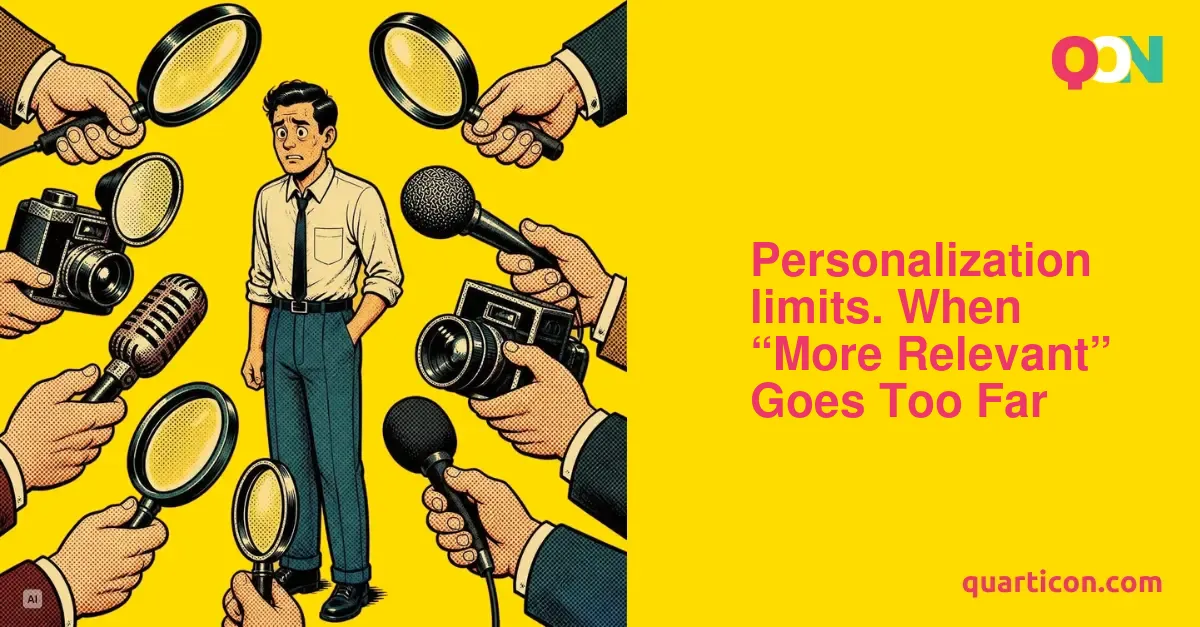
Recent research* challenges the assumption that more personalization always produces better outcomes. Instead, it suggests an inverted-U relationship: customer satisfaction and loyalty improve as personalization increases up to a certain point. Beyond that point, excessive personalization can trigger discomfort, distrust, and a sense of manipulation.
At the same time, consumers continue to express strong concerns about privacy while willingly sharing data for convenience, discounts, and personalized experiences. This tension, known as the privacy paradox, is more complicated than simple inconsistency or hypocrisy.
Together, these patterns reveal a deeper problem: e-commerce systems may be designed to collect and use more data than customers are comfortable with, while offering too few meaningful ways for people to control that process.
The Myth That More Personalization Is Always Better
Personalization can clearly create value. A relevant product recommendation is more useful than a random one. A customized promotion may help consumers discover products they genuinely want. A shopping experience that remembers preferences can save time and reduce friction.
However, the relationship between personalization and customer loyalty is not unlimited.
At low levels of personalization, customers may receive generic experiences that fail to reflect their interests. As personalization becomes more sophisticated, satisfaction and engagement may improve. But when personalization becomes highly detailed, persistent, or unexpectedly accurate, the experience can cross an invisible psychological boundary.
Customers may begin to wonder:
- How does this company know so much about me?
- What information is being collected?
- Am I being helped or manipulated?
- Can I control how my data is used?
- What else does the company know that it has not revealed?
This is the point at which personalization can begin to undermine the very trust it was intended to build.
The Personalization Curve
The research suggests that approximately half of consumers exposed to hyper-personalized advertising report negative reactions, including feeling manipulated.
That figure has major implications. If personalization makes a substantial portion of customers uncomfortable, then data-intensive marketing may produce diminishing, or even negative – returns.
The goal should not be maximum personalization. It should be appropriate personalization.
| Level of personalization | Likely customer reaction | Business consequence |
|---|---|---|
| Minimal | Generic, impersonal experience | Missed opportunities for engagement and loyalty |
| Moderate | Relevant, useful, and convenient interactions | Stronger satisfaction and customer value |
| Excessive | Discomfort, suspicion, and “creepy” feelings | Reduced trust, negative sentiment, and possible churn |
Why Data Maximization May Be Bad for Business
Many organizations treat data collection as an unqualified asset. The assumption is that more information enables better predictions, more precise targeting, and stronger customer relationships.
But information has value only when it produces outcomes customers appreciate.
Beyond the optimal level, personalization may:
- Reduce customer trust
- Increase perceptions of manipulation
- Encourage ad avoidance or account abandonment
- Damage brand reputation
- Increase customer churn
- Generate negative word-of-mouth
- Produce lower returns on data and technology investments
This changes the business case for personalization. The question is not simply, “How much data can we collect?” It is also:
“How much personalization can customers comfortably receive before the experience becomes counterproductive?”
A company may be able to predict a customer’s needs with remarkable accuracy and still lose that customer if the experience feels invasive.
From maximum ineffective personalization to minimum effective personalization
The objective is not to identify customers as completely as possible. It is to provide the most useful experience with the least amount of customer data necessary. Move from identity-intensive personalization toward context-aware, purpose-limited recommendation systems, using CDPs only where an identifiable customer relationship creates clear value.
CDP can create maximum ineffective personalization of a small portion of your traffic, but marketers should think rather about minimum effective personalization that reaches 100% of the traffic.
A recommendation engine can work with anonymous session behavior, contextual signals, item similarity, or aggregate patterns. A CDP is mainly useful when the company needs cross-channel identity resolution, consent enforcement, lifecycle orchestration, customer-service context, or suppression rules.
Learn more about product recommendation engine ← here, or schedule a demo.
*The Personalization-Privacy Paradox in AI-Driven Programmatic Advertising: Implications for Digital Marketing Sustainability, MDPI, https://www.mdpi.com/0718-1876/21/6/179