
The question should really be: “How does marketing automation not work in e-commerce?” It can fail for several reasons: it is triggered at the wrong time, in the wrong place, with the wrong product. Could it be even worse? We will vividly explain what happens in your store if you use only marketing automation or a CDP.
Recently, we discussed the topic of recommendations in a store in several scenarios: native recommendations from an e-commerce platform, recommendations in marketing automation and CDP, and recommendations from an AI recommendation engine. You can find that article here: Recommendations versus recommendations. Simple and vivid. Now, we are expanding on that topic–in the area of only these two types of tools: CDP and MA.
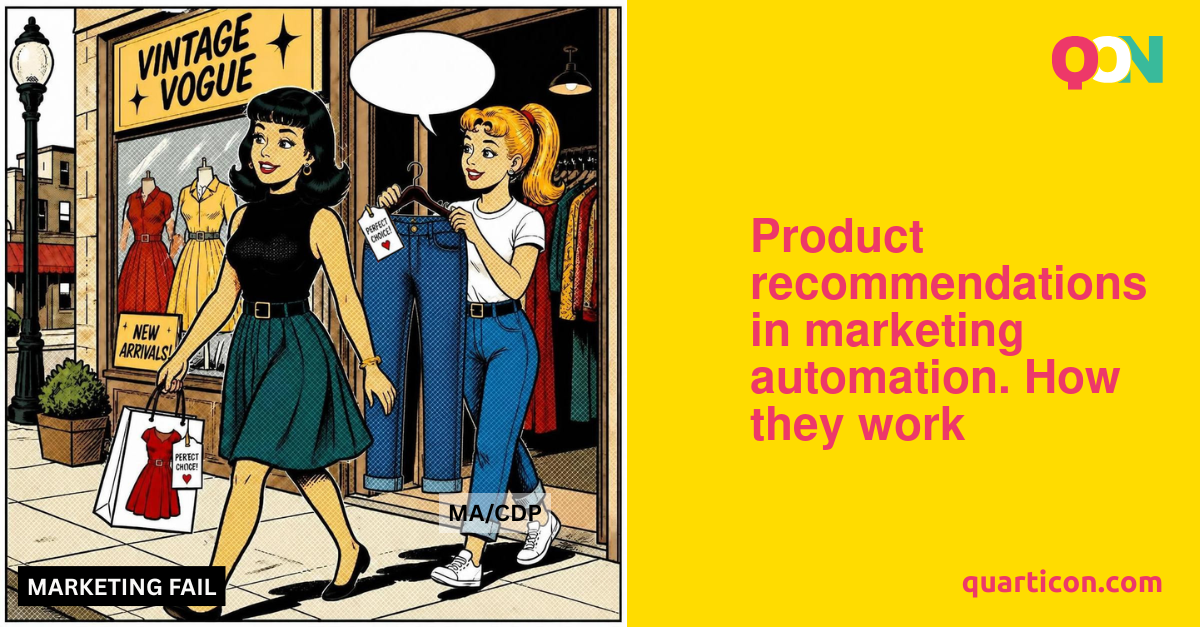
So let us start at the same point–in a clothing store, an ordinary one, on Ordinary Street. We know that T-shirts priced at 5 Euro sell best. White, yellow, and green ones. A new customer enters the store. She is browsing a red dress priced at 100 Euro. An assistant (the marketing automation / CDP system) steps in to offer advice in the store.
95% of cases: the system does not recognize the customer
So, a new customer enters the store. The assistant does not recognize her because either she is genuinely new or she has a short memory / is bad at recognizing faces (cookies being deleted, ad blockers, incognito mode). The customer is browsing a red dress priced at 100€.
The assistant approaches her and says: „You would be better off buying this T-shirt. It is only 5€.”
Fail! An assistant like that would not work in such a store for long, would she? And in a large part of e-commerce, an assistant just like this one (marketing automation) is actually employed!
This is exactly how “recommendation widgets” in marketing automation work for 95% of your customers. The system recommends whatever sells best, regardless of what the customer is doing.
It does not observe the customer or adapt to their needs in real time.

95% of your customers receive interruptions while shopping
To better imagine the drama of the situation, we need to replace the assistant, because it is impossible for anyone to comprehend an assistant making recommendations like that.
So we need to bring in a more “random” person–a technician who installs electrical systems.
The customer is browsing a red dress priced at 100€. The technician approaches and says: „I have been sitting here since morning, and lots of people are taking these white T-shirts. You would be better off buying one of those T-shirts.”
Fail! At best, such a technician would receive a reprimand from the owners: “Don’t interfere!” Meanwhile, for 95% of your customers, that is exactly what this man does–he interferes and gives them advice!

5% of customers – only this part was recognized
5% of customers are recognized. They did not manage to delete their cookies or unknowingly clicked on an email sent to them. What happens then?
So let us start again–a recognized customer enters the store. This is Barbara (we remember that Marian went to buy a new television).
The assistant shouts from the doorway: „Good morning, Ms Karen!”
This is where the magic of marketing automation systems happens. The system has recognized the customer.
Ms Karen is looking at the red dress priced at 100€. The assistant, as we mentioned–a clever beast–remembers that Ms Karen bought trousers a month ago, so she suggests: „Ms Karen, we have some great trousers on sale.”
Fail! The assistant (marketing automation) relies on historical data. The system reacts to what the customer bought previously, not to what she is doing now. The only thing that has changed is that instead of a white T-shirt, we now have personalized blue jeans.
So, I wonder when the assistant (marketing automation) will realize what is happening and react?

The checkout: is it finally happening here?
It might seem that checkout is finally a place where the system can adapt.
But no! The assistant (marketing automation) is still working with historical data. Ms Karen is in the “bought trousers 30 days ago” segment, so the assistant follows her around with trousers.
The segment cannot be changed that easily. It can be modified. So the owners train the assistant: when people who bought trousers come in, do not offer them trousers–offer them a belt instead. So the assistant follows the customer around the store with a belt.
Is it better? Probably not.

What happens after the purchase?
Unfortunately, the assistant (marketing automation) has still received very little information after the purchase. It does what it has been told and does not make autonomous decisions.
Only in the morning, after analyzing the data, will the owners modify the segments and give the assistant new instructions–Ms Karen is no longer in the “bought trousers” segment. As of today, Ms Karen is in the “bought dresses” segment.
But today, after leaving the checkout, Ms Karen is still in the bought-trousers segment as far as the assistant is concerned. So it runs after her with trousers.
Why? No one knows the answer to that question.
However, leaving the checkout is the moment when marketing automation receives new data and starts using it. Like hyenas, it pounces on customers who have already bought something and encourages them to make another purchase. FAIL again!

Where does the magic begin? Nowhere, really
Yes, nowhere, really. But CDP and marketing automation claim that they can reach customers through omnichannel communication. Outside the store, in a place of entertainment. But this is where the real downfall begins–not the magic.
The next day, Ms Karen goes to the cinema (YT). The assistant received new instructions in the morning about the new “bought a dress” segment.
Since morning, it has been running around the city after Ms Karen with a dress. “Ms Karen – have a look at this nice yellow dress. Maybe you could buy it as well.”
Once again, why? No one knows. Bad timing, very bad timing …
Here, we have made a major simplification–it is not the assistant running around the city, but another retargeting system. The MA system merely pretends to take part in it. So the assistant would have to be replaced by another assistant. But more on that in the next part.

Marketing automation / CDP – what went wrong?
In short, what went wrong after implementing marketing automation and CDP in e-commerce:
– in the store, it does not really deal with customers, but only with those it recognizes
– if it recognizes them (5% of customers), it works with historical data that currently makes no sense
– it starts targeting the customer after the transaction, when it is essentially already too late
– retargeting recognized customers makes no sense–it is already too late
So why does everyone think it works and delivers results? It is all about statistics, but more on that in the next part.
What is the alternative?
Most e-commerce businesses rely on systems that, at best, update when the customer last logged in. It is like our assistant suggesting trousers instead of observing what is happening now.
AI product recommendation engines work differently: they adapt instantly, learn from every interaction, and work for everyone, whether the customer is new or returning.
It is the difference between:
- A system that shouts: „Buy what everyone else is buying!”
- A system that listens: „I can see that you like this dress, and I know a similar one that you will like even more.”
You can see the difference, right? It is not just about whether things will get better simply because they will. It is also about how to stop causing harm immediately. Because the first and second scenarios damage the customer experience.
Book a demo to learn more.
For those who want to explore the topic in less visual terms, visit our website: product recommendation engine